



Marine mammals can’t tell us directly how their environment is changing.
But sometimes their behavior can.
Changes in distribution.
Changes in migration timing.
Changes in habitat use.
Changes in population trends.
An individual observation may offer only a glimpse. But when observations are collected consistently over time, they can begin revealing patterns that might otherwise remain invisible.
That’s one of the remarkable things about environmental data.
It allows us to see beyond the moment.
Looking for Patterns
Imagine observing a species in a particular location.
That tells us something useful: the animal was there.
But what if researchers record similar observations repeatedly?
Now we can begin asking different questions.
Does the species consistently use this area?
Does its presence change seasonally?
Are mothers and calves observed there?
Is feeding behavior common?
How do environmental conditions compare when animals are present versus absent?
Then consider those same questions across multiple years.
The observations haven’t simply accumulated.
They’ve gained context.
When Change Becomes Visible
Environmental change isn’t always dramatic.
Sometimes it happens gradually.
A species begins appearing slightly earlier.
Animals spend less time in a historically important area.
Sightings become more frequent somewhere else.
A behavior that was once uncommon becomes increasingly noticeable.
Any one of these observations could easily be dismissed as an anomaly.
Long-term datasets allow researchers to ask whether they are part of something larger.
That ability—to distinguish a moment from a pattern—is one of the reasons consistent monitoring is so important.
The Importance of Context
Data become especially powerful when different kinds of information remain connected.
Where was the observation made?
When?
What species was present?
What was the animal doing?
What were the environmental conditions?
Were photographs or recordings collected?
Were other species nearby?
Context allows researchers to move beyond what happened? toward why might it be happening?
Not every dataset can answer every question.
But well-preserved observations give future researchers more possibilities.
From Information to Understanding
At WatchSpotter, we often describe this transition as moving from environmental observations toward environmental intelligence.
That doesn’t mean software somehow knows what the ocean is telling us.
Scientists do that.
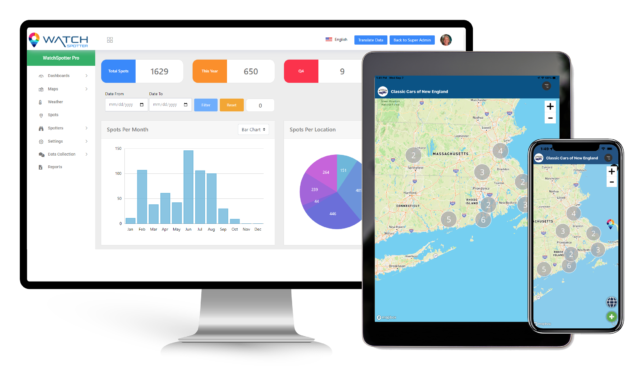
Environmental intelligence simply reflects the idea that information becomes more useful when it can be organized, connected, visualized, and understood in context.
Technology can help researchers see the pieces.
Scientific expertise determines what those pieces mean.
That distinction matters.
What Is the Ocean Telling Us?
The ocean is constantly changing.
Some changes are natural.
Others may reflect broader pressures on ecosystems.
Our ability to understand the difference depends on observations collected by people around the world, often over many years.
Every sighting adds another piece.
Every survey adds another chapter.
Every field season extends the story.
The challenge isn’t simply collecting information.
It’s making sure the observations we work so hard to collect remain useful enough to help us ask better questions.
Because the more clearly we can understand what is changing, the better prepared we are to decide what comes next.